Classification of Connective Tissue
What is connective Tissue?
Connective tissue fills the spaces between organs and tissues,
and provides structural and metabolic support for other
tissues and organs.
Connective tissue is made up of cells
and extracellular matrix.
The extracellular matrix is made up of fibres
in a protein and polysaccharide matrix, secreted and organised
by cells in the extracellular matrix. Variations in the composition
of the extracellular matrix, determines the properties of the
connective tissue. For example, if the matrix is calcified, it
can form bone or teeth.
Specialised forms of extracellular matrix also
makes up tendons, cartilage,
and the cornea of the eye. General connective tissue is
either loose, or dense, depending on the arrangement of the fibres.
The cells sit in a matrix made up of glycoproteins,
fibrous proteins and glycosoaminoglycans,
which have been secreted by the fibroblasts, and the major component
of the matrix, is in fact, water.
Classification
CONNECTIVE TISSUE PROPER (examples of these are shown
below)
- loose irregular connective tissue
- dense irregular connective tissue
SPECIALISED CONNECTIVE TISSUES
The ECM is the predominant
feature in tissues with a mechanical function
(ligaments, tendon & bone).
Cells are the predominant feature
in tissues specialised for protection (haemopoietic
tissue, blood - white blood cells) or metabolic maintenance (adipocytes,
blood - red blood cells).
Connective Tissue Proper
Loose connective Tissue
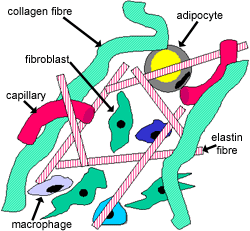
This is an example of loose connective tissue from a lymph gland. It contains some cells called 'plasma cells',
finer elastin fibres and thicker collagen fibres. Try to identify the cells and fibres
This type of tissue contains many cells, a loose arrangement of fibres, and moderately viscous fluid matrix.
Dense Irregular Connective Tissue
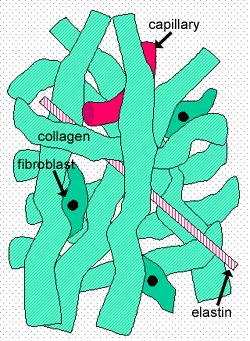
This is an example of dense irregular connective tissue. It is the layer of skin underneath the epidermis, called the dermis. It contains collagen fibres and fibroblasts. Also at the top of the picture (not labelled) you can see a small capillary - can you find it?
This type of tissue contains a dense woven network of collagenous (and some elastic) fibres in a viscous matrix. It is found in joint capsules, in the connective tissue that envelops muscles (muscle fascia), and it forms dermis of skin. It is impact resistant.
Look at this image and make sure you can recognise loose and dense connective tissue.
Specialised connective tissue
Dense Regular Connective Tissue
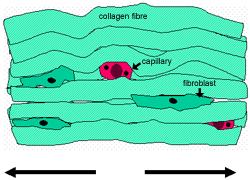
This is an example of dense regular connective tissue. Can you identify the cells (fibroblasts) and collagen fibres?
Notice how the fibres are all aligned.
In this type of tissue, the collagen fibres are densely packed, and arranged in parallel. This type of tissue is found in ligaments (which link bone to bone at joints) and tendons (connections between bones or cartilage and muscle). These are powerfully resistant to axially loaded tension forces, but allow some stretch.